


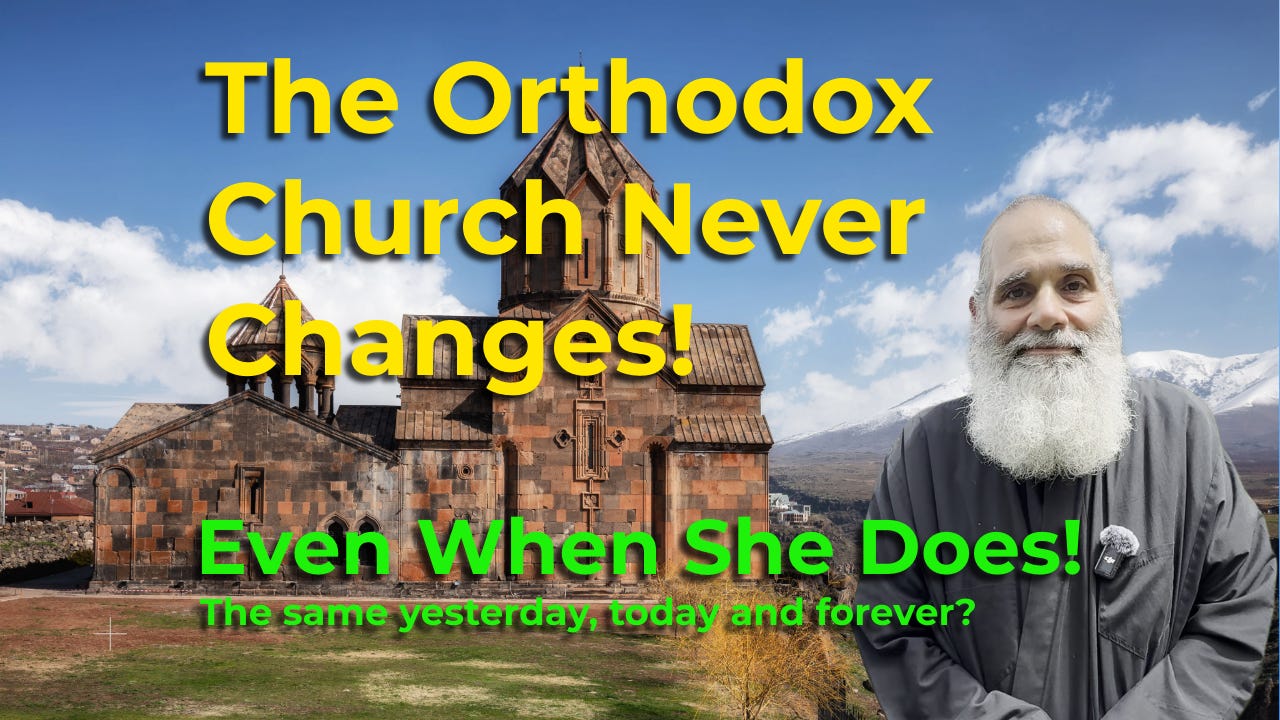
Transcript of video, “The Orthodox Church Never Changes | Even When She Does!” Click here to see the video on YouTube.
Transcript:
We can say with absolute certainty that the Orthodox Church is unchanging, and that she has not changed in her substance which is from the beginning, nor in her mission which was given to her by Christ at His Ascension[1] and to her Apostles when they received power to carry out that mission at Pentecost. At that time, the Holy Spirit came on Apostles as something like “tongues of fire” the scriptures say, and they spoke the things of God in the languages of all nations.[2] And now their message and their faith continues to go out to all the world. How can I make such a bold and audacious claim? As we will see, the answer is rooted firmly in our understanding of the incarnation of Christ! It’s important to understand this correctly, otherwise you’ll be confused and distracted from what will save you.
There is great interest now in the Orthodox Church as an ancient institution that preserves what is good and holy in a world where everything else is changing and under attack. The Church is seen by many – correctly – as an anchor in a tumultuous world. A fixed reference point that is used to measure everything else. And it is all that, as we will see.
Many people today erroneously see the Church as a “human institution” that was – in the most charitable versions created by Christ and handed off to his Apostles right before He ascended into heaven. They argue that since the Church is a human institution, she is subject to all the human frailties and failings. The argument goes that as the Apostles died off and the Church spread by word of mouth, the Church was left without divine guidance, left alone to figure things out on her own. And like all things – they believe that Church underwent a period of “evolution”. They see evolution everywhere! And what we have today is not the same as what the Apostles taught, but an expanded, “evolved”, institution that is only in some metaphysical and disconnected way “the body of Christ”. As if to say, “the Church is the Body of Christ” is to speak metaphorically. But nothing could be further from the truth!
This comes from a misunderstanding of what the Church actually is, or should I say, “who” the Church really is! In this video, we’ll solve this problem of the changing Church by looking at the true nature of Church to understand why the assertion that the Church has changed is false.
To understand this, let’s look at what the Church really is. The Church herself is an extension of the incarnation of Christ. The members of the church are members of the body of Christ. And of course, Christ is the head. We Orthodox say this in a plain and literal sense – and we mean it. The Church is the visible, incarnate body of Christ which can be seen. And we refer to the Church with personal pronouns because according to the Scriptures, she is in fact the bride of Christ and salvation is a wedding feast.[3] The members of the Church are joined to Christ by their participation in the mysteries of the faith as they practice them.
St. Justin Popovich who lived from 1894 to 1979[4], and is a saint of the Serbian Orthodox Church and a gifted theologian and professor of theology used the term “theanthropic” to explain how this works. I’ll put a link below so you can read his whole article. He said that the church is a “theanthropic organism.”[5] Theanthropic is a fancy word that’s a combination of two Greek words, “theos,” which means God, and “anthropos,” which means human. So the Church is a God-human organism, because Christ is the God-human man. The humanity of the Church is divinized by His presence. St. Justin explains that because the Church is theanthropic, whatever attributes she has are the attributes of the Lord Jesus Christ, who is also called theanthropos, the “God Man”.
OK – now we know we can safely use the same language we apply to Christ to describe the Church. How do we this? The Fourth Ecumenical Council stated dogmatically that Christ has two natures. He has a human nature which means He is the same in substance us human beings – He is fully human, and He has a divine nature, which means he is same substance as God the Father – He is fully God. The fathers of the Fourth Ecumenical Council came up with some brilliant language to help us make the distinction in Christ and still remain Orthodox. They declared the two natures exist in one person of Christ at the same time, but they are without “confusion, change, division, and separation”. There is a voluntary one-way “sharing of attributes” in Christ where He – the Son of God who is the Second Person of the Holy Trinity, voluntarily takes on the human nature in the incarnation with all of its attributes to heal it, and to divinize it.[6] Note that neither sin nor the propensity to sin are NOT attributes of human nature! This means that when we speak of Christ in what He does in His human nature, we put the words “insofar as He is human” in front of or after whatever it is we are saying. When we speak of Christ in terms of His divine nature, we put the words “insofar as He is God” in front of or after whatever it is we are saying, and thereby we avoid becoming heretics, which is a very good thing! We can apply this to the Church.
So - insofar as Jesus is human, He was conceived by the Virgin Mary[7], He was born[8], He grew in wisdom and stature[9]. He died on the cross[10]. He rose from the dead.[11] But insofar as he is God, he did not die because God cannot die.[12] And insofar as he is God, He has all wisdom, knowledge, and power. He took on human attributes willingly.[13]
St. Justin made the connection between the dual nature of Christ and the dual nature of the Church. The church can be described exactly the same way. Insofar as she is human, the church changes to adapt herself to the time and place she’s ministering in. But insofar as the church is divine, she never changes. More on this later.
Let’s look at what the Second Ecumenical Council[14] consider to be the four most prominent divine attributes of the Church that never change. The Creed of the Council says in part, “We believe in One, Holy, Catholic, and Apostolic Church.”[15] These words were added to the Creed to clarify this teaching way back in the Second Ecumenical Council in the year 381, when there was a dispute that needed settling. The council was not defining something new. It was just clarifying settled teaching.
Briefly, this statement means that the Church is one, which is to say she is unified there’s only one Church. The Church is holy, which means she is of God; not of human origin. The Church is catholic, meaning she is universal across all the world. And the Church is Apostolic, meaning she teaches what the Apostles were taught by Christ.
These four things never change. The purpose of the Church is to teach all human beings how to love their neighbor with no expectation of return; i.e. to love without condition. This is divine love that is only possible when human beings are free of their passions, and that — as St. Paul says - only happens through Jesus Christ[16], even if people who are healed do not recognize Him as he heals them.[17] This is the only way to love God, to love neighbor, and thereby fulfill the Commandments of Christ which give life.
The church does adapt herself to the time and place in which she ministers to people. The Divine Liturgy and various services also are adapted over time. This means that the ways in which we do what the church has always done can be different and can change from century to century as she finds herself in different cultures and different places around the world. But is this really a change to the four attributes defined in the Creed?
Now this is the part that really helps to understand why it is that the church doesn’t change, even if she adapts herself to time and place.
Let’s go to the scriptures for this. St. Paul’s letter to the Hebrews, chapter 13, verse 8 says, “Jesus Christ is the same yesterday, today, and forever.”[18] So let’s not be worried that the church is changing or could ever change. Like Christ, she is the same yesterday, today, and forever. Now think about this. Jesus did change – insofar as He is human. As we say, He was conceived in the womb of the Virgin Mary, and He grew. That’s change. And He was born, and He grew further, and the scriptures say He grew in wisdom and in stature.[19] And when He was fully grown, He went to the cross, and He died a real death on the cross. That’s also change – but all these things are attributes of His human nature, and it is proper for them to change. In His divinity He does not change – this allows the Apostle to say He is the same yesterday, today, and forever. These two natures exist in one person, and it is truly the Son of God who was conceived, who grew, who died – in the flesh – insofar as He is human. He brings both natures together in one person. It is the bringing together that is the mystery – and so it is with the Church. She unites Christ and human beings, and is the same, yesterday, today, and forever.
Insofar as she is human, the church makes adaptation, as is necessary to minister to human beings and to care for them. The Church is also made up of human beings who are born, and grow up, and become altar servers, and bishops and deacons and priests and patriarchs, and then they die. And the next generation continues on. But the one thing that remains the same, the one thing that never changes because it can’t change, is Jesus Christ. He’s always the same. He’s always the head of the church – the “who” the Church is, and the people in the church are always members of his body, included by His grace.
The Church therefore adapts herself to the time and place in which she is living. She changes language, custom, communication methods, etc., in service of her mission to make disciples of all nations.[20] For example: how has the celebration of the Eucharist changed since the time of the Apostles? It has gotten longer, and prayers have been added, and then people were added to serve as the Christian population grew, and more languages were used. And the Divine Liturgy can be celebrated pretty much anywhere, under a tree, outdoors in an open field, in someone’s house, in a proper church. But no matter when, or where, or how the Church always recognizes the presence of Christ in the breaking of the bread.[21]
So, the only thing that changes about the Church is the way she adapts herself to serve the human race. The head of the Church which connects the whole body together is Christ and He never changes. The Church understands herself to be the visible reality of the incarnation of her founder, who is Christ who is Theanthropos, which makes the Church also theanthropic through Him, her head. Through the sacraments she can be located in time and space, she is not abstract and invisible but incarnate and seen in the people and the clergy who serve them.
Why is this so important now? Because it is your guarantee of the authenticity of the Church. Christ has preserved in the Orthodox Church the faith He himself handed to the Apostles. Christ has guided His Church actively since the death of the last Apostle, His friend St. John the Theologian who died sometime in the late first century. There has never been a time when Christ did not actively shepherd His Church on earth, and now that Church has come to America, through the Russian Orthodox Church evangelizing the native peoples of Alaska and from immigration from Greece, Russia, Serbia and the Middle East, and as time went on every region of the Orthodox world, and now the Church comes to Americans from their own population. She has spread across the North American continent and is growing quickly! Now understand this about the Orthodox Church – insofar as she is human and she changes some things, she changes *very* slowly, and not very much. It takes a long time for things to happen within the Church structure.
To get an idea of how slowly things change, let’s look at the most important service we have: the Divine Liturgy that you attend every Sunday and at other times during the year. If you went to an Orthodox Divine Liturgy at the end of the first millennium – about 1025 years ago – you would immediately recognize what is going on. At that time a difference was in when the liturgy started and where. People would chant psalms on the way to the church building that we now sing in church. And the Liturgy would begin after the bishop arrived in church. By the 14th century you would now see things done pretty much as we do them today. The use of the relatively new invention of the printing press created fixed, reproducible rubrics during the late 15th to early 16th centuries[22] and has not changed very much since then. Therefore, over the last 600 to 1000 years, if you went to any Orthodox Church service, you would recognize the Liturgy as Orthodox, and in the last 600 you would see pretty much what you see now in America, except that here we offer it in multiple languages including modern English.
Let me just add, his is a wonderful attribute of the Church. If you raise your family in the Orthodox Church and your children grow up and they have their own children,(...) when they bring their children to church, they are going to do the same liturgy they did. Across generations, they all have the same experience with the same liturgy in church. The gift of permanence and stability.
This is because the very culture of the Orthodox Church is resistant to change. In that culture, when we desire to change something, we ask ourselves, why are we changing this? Is it to adapt ourselves to the needs of the people, or is it for change’s sake?
So, when we hear the debates online about the church changing, let’s remember that insofar as she is human, the Church adapts herself to the times in order to carry her message. But the message is divine and never changes – the “who” in the Church is Jesus Christ – and with the Apostle Paul, we can say He is “the same yesterday, today, and forever.”
So how about you? When you hear about the Orthodox Church being unchanging, and then somebody points out all the changes that have occurred since the time of Christ, does that bother you? Does this idea of the Church being theanthropic help you in any way to understand what change is and why it happens? Share your experience in the comments below.
[1] Matthew 28:19
[2] Acts 2:1-41
[3] Ephesians 5:25-32, Revelation 19:6-9, Ephesians 5:25-27, 31-32, 2 Corinthians 11:2, John 3:28-29 and numerous others.
[4] OrthodoxWiki, s.v. “Justin Popovich,” last edited May 30, 2022, accessed September 28, 2026, https://orthodoxwiki.org/index.php?title=Justin_Popovich&oldid=130145.
[5] Justin Popovich, “The Attributes of the Church,” trans. Stephen Karganovic, Orthodox Life 31, no. 1 (January–February 1981): 28–33, reproduced by Orthodox Christian Information Center, accessed September 28, 2026, http://orthodoxinfo.com/general/attributes.aspx.
[6] Philippians 2:5-9
[7] Matthew 1:23
[8] Luke 2:7, Luke 2:11, Matthew 1:21, Matthew 1:23
[9] Luke 2:52
[10] Matthew 27:27-54, Mark 15:21-41, Luke 23:33-46, John 19:16-37
[11] Matthew 28:5-6, Luke 24:6-7
[12] 1 Timothy 6:16, 1 Timothy 1:17
[13] Philippians 2:5-8
[14] Orthodox Church in America, “The Second Ecumenical Council,” in The Orthodox Faith, vol. 3, Church History, accessed September 29, 2026, https://www.oca.org/orthodoxy/the-orthodox-faith/church-history/fourth-century/the-second-ecumenical-council.
[15] Greek Orthodox Archdiocese of America, “The Nicene Creed,” accessed September 28, 2026, https://www.goarch.org/-/the-nicene-creed.
[16] Romans 7:14-25
[17] Matthew 25:40
[18] Hebrews 13:8, NKJV
[19] Luke 2:40
[20] Matthew 28:19
[21] Luke 24:35
[22] The first printed Byzantine edition was in 1526 edition. (Robert F. Taft, “How Liturgies Grow: The Evolution of the Byzantine ‘Divine Liturgy,’” Orientalia Christiana Periodica 43 (1977): 355–78, reproduced by Apostoliki Diakonia of the Church of Greece, October 27, 2014, accessed September 26, 2026, https://apostoliki-diakonia.gr/en/the-evolution-of-the-byzantine-divine-liturgy/.). The first Slavic edition was printed in 1491. (Michael Pomazansky, “Liturgical Books: From Manuscript to Print,” Missionary Leaflet E077, ed. Alexander (Mileant) (La Cañada, CA, 2005), accessed September 26, 2026 https://www.fatheralexander.org/booklets/english/liturgical_books_pomazansky.htm.)